How to have executive function
a.k.a. "the scary Jeremy protocol"
MEETINGS
What you get out of a meeting is roughly proportional to how much you’ve thought about the contents before.
- This means prepare for your meetings.
- If you have not done the preparation, you can ask for a silent start for the first few minutes where you read and comment on, or write out, your prep.
- If you’re missing someone during the meeting, pause and call them to ask them to join, rather than continuing without them.
- See this post from Li-Lian: a 1:1 with your manager is successful if you find it helpful. https://lilianang.substack.com/p/1-1s-at-bluedot
Be attentive during meetings.
- Know what is going on at all times. At every moment, consider: “if someone called on me to recap what is going on in this meeting, do I have a concise answer?”
- If someone says something and you do not feel comfortable explaining it to a stranger, then you do not understand, and you need to ask for clarification.
- Be prepared to answer “what is your two-sentence recommendation for what we should do here?”
- Someone in the meeting should keep track of time. Have a running sense of how long to spend on each item, or emergent conversation topic. Call out if you or someone else has a hard stop.
- Underpromise and overdeliver. It is okay to say that you do not have an answer yet or a timeline for a thing and will get back to them later.
You control your schedule. Other people do not control your schedule.
- Your time is very important.
- My protocol for outside meetings: “Send me prep 24hrs in advance. These can be bullets, I just want to see that you're justified talking to me. Also, giving me time to prep helps me help you. I will kick the meeting out further or cancel it if you do not do this.”
- You are allowed to reschedule meetings.
SELF
Start each day by asking “what is the highest leverage / highest priority thing to do?” and then do that thing.
- Make a list of three things, write them down, and then do those. You can probably only do around three real things in a day. See this post: https://fictivekin.github.io/pmarchive-jekyll/guide_to_personal_productivity.html
- ( While we’re on the topic of productivity articles, see this post: https://guzey.com/productivity/ )
- I also have three main priorities during the week.
- You should keep track of your TODOs in a way that works for you. I just have one big-ass Google Doc. Everything inbound to me gets added to this scratchpad.
Use your best judgment. It may be the best judgment that we’ve got.
- There are no adults in the room. I am reminded of this quote from Lindsey Graham:
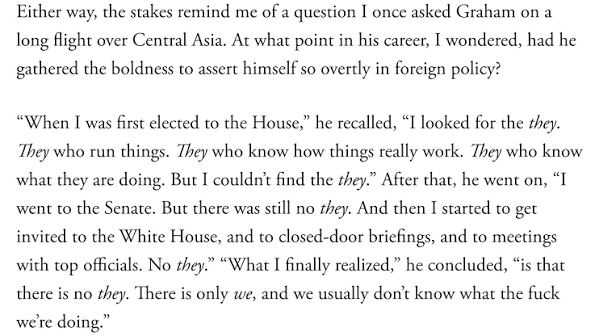
- I have felt weird about setting priorities and deadlines because I’m waiting for someone to give me “the right answer.” There is no right answer and there will not be a right answer. There are only better ones.
Be proactive.
- Threaten to do things. “By default, I will do X by Y date, unless @A suggests otherwise.”
Consider the full option space and be creative. It is rare that the only options are “yes” and “no.”
- To give an example here, when making application decisions, there’s actually a lot you can do. You can accept or deny. You can send them a tailored, nice email, or ask them to hop on a call. You can connect them with other people in your network that are better positioned than you at helping them. There’s way more options here than this too but I can’t reveal them.
- Having previous experience means you have creative options cached. This is why having a mentor is useful.
Have a designated time-to-response for any communication channel to you.
- It can be a few minutes or a few weeks.
- Generally if someone puts a ball in your court that’s under two minutes, and you’re not in a focused work block, just do the thing.
Assume that you’re good.
- Feedback from the team once: “It feels like you’re approaching some items like you are a student who was secretly hired, rather than an employee that we trust.”
- I felt like I was failing or doing something wrong if I didn’t receive positive feedback or something. I was approaching work from a place of fear.
- I decided one week to just assume that I’m doing good work unless told otherwise during a review meeting or something.
I have often found my bottleneck for work-relevant unhelpful patterns to be related to how I interact with my emotions.
- Work may not be the best environment to work through this.
- I have a weekly 1:1 with a friend of mine where we review the last week, plan for the upcoming week, and are down to digest and process these. See this post. https://www.benkuhn.net/11/
Notice early warning signs of burnout and respond proactively if you can, reactively if you must.
- “If you do not schedule breaks, they will be scheduled for you.”
- It need not be a full day either. If I notice that a day is not going to plan, I just “cut my losses” and go home early and recharge.
OTHERS
Every item, no matter the size, must have an owner.
- When you message someone, give all the details relevant to put the ball in their court.
- (If the ball is still in your court, then it’s just an FYI message, which is fine.)
Ask for help.
- If you’re unsure about something, post it in a public channel and get other people’s input.
Make it easy for other people to help you.
- There are lot of fucking things to do and not enough time.
- When posting a message to a channel, you can ask them to react with emojis rather than writing out responses.
- In meetings with your manager, you should come up with your best recommendation for any action, so they can thumbs up / thumbs down.
- In cases where you’re unsure of your recommendation, you should strive to communicate the context you have on the problem, so they can use their best judgment.
Have situational awareness.
- You should have at least some sense of the company’s priorities.
- You should have a sense of your manager’s priorities.
- You make better fuzzy judgment calls when you do this.