how to write an essay
Congratulations. You have just asked someone who likes writing about writing advice, which means even though it's ungodly early in London and the highest expected value play is to go back to sleep, I physically cannot, because there is an extra beating heart in my chest and I need to exorcise it before it vanishes.1
First things first: I cannnot speak to technical writing because I have not done technical writing. What I can do is tell you is what I appreciate about nonfiction writing that develops ideas, and you decide how much of that transfers to your situation.
Good writing tells a story, and stories start by getting me to care. Scott Alexander's most recent post on writing advice links this cool example:
"Hammurabi was the king of Babylon. He reigned about 3800 years ago in Mesopotamia, in what’s now Iraq. You may have heard of his code of laws. I say “about” 3800 years ago because there are several possibilities for exactly when he reigned. Right now, the leading hypothesis is 1792-1750 BCE, but it could also be 1848-1806 BCE, or 1728-1686 BCE. Or even 1696-1654 BCE . . . If we’re uncertain, why are those dates so specific?"
This has conflict - the conflict between the different sets of dates. It has mystery - why are the dates so precise? This was a good use of this post’s runway, which kept me reading further.
Once you have motivated the idea, you must describe how you arrived at your conclusions. Your finished piece should allow the reader to build a gears-level model of the situation. I find the process best described in this post on writing quickly while maintaining epistemic rigor.
Remember: method, not results. Don't cling too tightly to the idea of a finished piece, because that prevents you from producing it. In practice what you do is spend a fuck ton of time putting an idea on paper and then refining it. In my process, I word-vomit out on a sheet of paper without regard for how nice it looks, because once I have the clay, I can start shaping it.
How do you shape your essay? Well, this is the fun part. You trim it down. You make it simple. The art of writing is like still life painting: you are constantly flicking your attention between your words and reality, sticking a thumb out and shutting an eyelid, gauging the fit, and adjusting things as you go.2
Writers love writing about this part. You're going to find a litany of posts about the mechanics of writing:
- For simplifying things, follow the rule that "if you read only the first sentence of every paragraph in the essay, it should still make sense," and also check out Scott Adams's The Day You Become a Better Writer.
- Ben Kuhn has a post on writing, and it has an appendix with writing quality tips.
- Or points 1 and 5 of Scott Alexander's 2016 post on nonfiction writing.
- Finally: Don't just write words, write music.
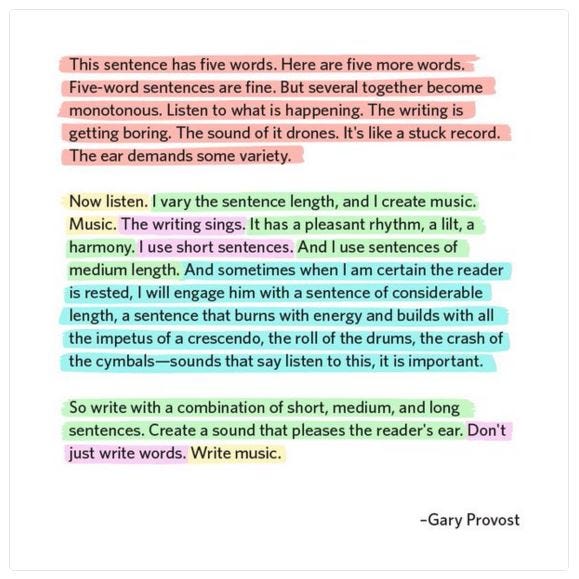
Once it's at a workable point, send it out to friends for comments. This is actually the only current place where I think you can use AI in your workflow and still produce high-quality ideas. I strongly agree that if you let AI do your writing, I will come to your house and kill you, but it also seems a shame to leave workflows like this on the table:
the level of nuance is just so wild, i can voice dictate for 5 minutes about some stack of theories i have and how they interact and it can find exactly the flaw in paragraph 17 and i'm like wow yeah you're right and i cant get that with humans
I suppose what I'm trying to get at is that you should use AI as a sparring partner rather than a forklift.3
Once you have incorporated feedback, the post is good to go. Hit publish, obsessively check the comments and upvotes for the next 24 hours, and then forget about until someone comes up to you and says "I read that post of yours!" and you can say, "What? Oh, that post," and then geek out about it.
Cheryl Strayed, tiny beautiful things: "I’d stopped being grandiose. I’d lowered myself to the notion that the absolute only thing that mattered was getting that extra beating heart out of my chest. Which meant I had to write my book. My very possibly mediocre book. My very possibly never-going-to-be-published book. My absolutely nowhere-in-league-with-the-writers-I’d-admired-so-much-that-I-practically-memorized-their-sentences book."↩
A weird thing happens when you write enough essays: your thoughts start to bloom in the form of an essay. You start structuring it, coming up with hooks, guessing at its structure. I don't know if this is a good thing or not. I think it might constrain your thinking in some ways, but I think it's quite neat.↩
There's nothing that turns me off harder than seeing something that is clearly AI generated, even if it's clever. Why is this? I think Paul Graham gets at it here. "The sound of writing turns out to be more like the shape of a plane than the color of a car. If it looks good, as Kelly Johnson used to say, it will fly well."↩